SomaliCare

Get the latest news, culture, history, arts, religious, literatures, values and traditions about Somalis around the world. The information given here is factual and authentic and collected from the most reliable sources.

Saturday, January 31, 2015

Somalia making progress against Shabaab, 31 January 2015

Somalia making progress against Shabaab, 31 January 2015

Somalia has made progress in its fight against the Al-Qaeda-linked Al-Shabaab militant group, Somali President Hassan Sheikh Mohamoud has said.

"The Somali army has begun to extend its control to most areas of Somalia and terrorist operations have been restricted," Mohamoud told The Anadolu Agency on the sidelines of an African Union summit that kicked off on Friday in Addis Ababa.

He added: "Peace has begun to prevail in Somalia."

Since the outbreak of civil war in 1991, the troubled country in the Horn in Africa has remained in the grip of on-again, off-again violence.

Last year, fractious Somalia appeared to inch closer to stability after government troops and African Union forces – deployed in the country since 2007 – drove Al-Shabaab from most of its strongholds.

The militant group, however, has continued to stage attacks against government forces and African peacekeepers.

Mohamoud, for his part, described a recent visit by Turkish President Recep Tayyip Erdogan to Somalia as "historic."

"Turkey has been a strategic partner to Somalia," he said. "We appreciate efforts by the Turkish president to help the Somali people."

He went on to say that Turkish-Somali relations had moved "from cooperation to integration."

Erdogan visited Somalia last week – his second visit to the country in four years. Erdogan first visited Somalia in 2011 as Turkish prime minister at the height of the Somali famine.

Since then, Turkey has helped war-torn Somalia rebuild its crumbling infrastructure.
Posted by Unknown at 6:11 PM No comments:
Email ThisBlogThis!Share to XShare to FacebookShare to Pinterest

As Somali-American fights no-fly list, FBI says his brother is most wanted - Yahoo News

As Somali-American fights no-fly list, FBI says his brother is most wanted - Yahoo News

A federal judge on Friday asked whether the US government really has the right to keep people like Gulet Mohamed, a Virginia-based Somali-American, from flying without telling them why and giving them due process to fight such a designation.
In a twist that highlights the stakes, the FBI one day earlier put Liban Mohamed, Gulet’s brother, on its most-wanted terrorists list, alleging he has given material support to Al Shabab, the Somali-based terror group blamed for a deadly four-day attack in the Westgate Mall in Kenya in 2013. The FBI has put a $50,000 bounty out on Liban Mohamed, saying he’s dangerous because of alleged weapons training and an intimate knowledge of Washington, D.C., where he worked as a cabbie until 2012. A lawyer for Gulet Mohamed called the allegations baseless.
Federal Judge Anthony Trenga’s pointed questions, coupled with the most-wanted designation, provide a tense backdrop as US courts and culture continue a process of coming to terms with deep constitutional questions created by America’s reaction to the Sept. 11, 2001, terror attacks in Washington, D.C., and New York.
Recommended: How much do you know about terrorism? Take the quiz.
Last June, Federal Appeals Court Judge Anna Brown found part of the no-fly-list policy unconstitutional, ordering the US government to formulate a due process provision to give fliers a meaningful way to contest their inclusion on the list. Some 20,000 people, including 500 US citizens, are on the list, the FBI disclosed in 2014.
While Judge Trenga made no ruling on Friday, he asked several pointed questions of government attorneys at the hearing, including whether the US had ever created another program that deprived people of their liberty with near zero transparency. US authorities have said the list is, in fact, constitutional, since travelers can find other modes of transportation.
The secret no-fly list came into effect after Al Qaeda terrorists hijacked four jetliners and used them to attack the Pentagon and the two towers of the World Trade Center. The list is part of a well-guarded and concerted US anti-terror effort that critics say at times has skirted the balance between national security and constitutional rights.
In a court case that FBI lawyers have tried for four years to get thrown out, Gulet Mohamed contends that the policy violated his constitutional rights. What’s more, Mr. Mohamed, through his attorney, argued that the FBI began harassing Liban Mohamed after he tried to intervene on his brother's behalf in 2011 when Gulet was detained in Kuwait and was prevented from traveling to the US. Gulet Mohamed was allowed to return to the US after he filed a federal lawsuit, but his name remains on the no-fly list.
His lawyer contended that the FBI was playing hardball by apparently timing the unsealing of the arrest warrent against Liban Mohamed to coincide with his brother’s court hearing. The Washington Post reported that the FBI declined to address those allegations.
The agency has been accused of abusing the list before. Last April, the Center for Constitutional Rights filed a lawsuit alleging that four American Muslims were “among the many innocent people who find themselves swept up in the United States government’s secretive watch list dragnet.” The lawsuit alleged that when the men “declined to act as informants” for the FBI and to “spy on their own American Muslim communities and other innocent people,” they subsequently discovered they were on the no-fly list.
The agency has in the past contended that a low likelihood of people being mistakenly put on the list is in itself a constitutional safeguard, though it’s clear that federal judges have begun to apply more scrutiny to that standard.
Still, the FBI says its concerns about the Mohamed brothers are genuine.
“Liban Mohamed is believed to have left the U.S. with the intent to join al Shabaab in East Africa. We believe he is currently there operating on behalf of that terrorist organization,” the agency writes in its official blog. "Not only did Mohamed choose to go to Somalia and fight with al Shabaab, he took a prominent role in trying to recruit people and have them train with weapons.”
Gulet Mohamed’s attorney, Gadeir Abbas, told the Associated Press that Al Shabab had murdered the brothers' uncle and imprisoned their cousins. The FBI’s allegations “have no basis in fact," he said.
Posted by Unknown at 6:10 PM No comments:
Email ThisBlogThis!Share to XShare to FacebookShare to Pinterest

South Africa riots raise worry about anti-foreign sentiment - US News

South Africa riots raise worry about anti-foreign sentiment - US News

South African youths recently swept through an intersection in the heart of Soweto township, breaking into immigrant-owned shops and grabbing whatever they could — soda, a loaf of bread, sometimes even the shelves. Nearly 40 years ago, at the same intersection, young blacks marched to protest the white racist rulers of the time, drawing a bloody crackdown that shocked the world.
The recent looting and unrest that hit Soweto and other areas around Johannesburg was not as bloody as the anti-apartheid demonstrations and the ensuing bloodshed in 1976. But it alarmed a nation built on the ideals of racial reconciliation and underscored that, two decades after apartheid was replaced by the promise of a "rainbow nation," many South Africans remain marginalized by a lack of economic opportunity.
Resentment against foreigners stoked the looting and rioting in late January that killed six people and forced many shopkeepers to flee.
Joyce Piliso-Seroke, 81, was arrested in 1976 for trying to help the marching students, some of whom burned buildings linked to the apartheid state. The anti-government movements that once aired frustrations against white minority rule now control the state but don't have answers for the younger generation, she said.
"It's complete silence now in the country," Piliso-Seroke said, referring to the lack of effective prescriptions for fixing education and providing employment.
The weeklong disorder was sparked by the shooting of a 14-year-old South African boy by a Somali shop owner who believed he was being robbed. The rioting has died down and minibus taxis daily clog the road at the Soweto intersection. On the sidewalk, overturned crates and a discarded door form a stand where bruised bananas and leafy spinach, pieces of bright cloth and plastic buckets are sold. A decades-old dilapidated shopfront faces a recently built supermarket chain.
Rows of high-heel shoes and strappy sandals are laid on a faded floral bedsheet on the pavement at a shoe stall run by Morena Malefetse, 29, and Tshepo Tsosane, 27. It could have been an easy target for looters but they ignored the merchandise of local vendors, instead targeting a foreign-owned butchery and an electronics shop.
Malefetse and Tsosane condemned the violence against shops owned by people from Somalia, Ethiopia, Pakistan, Bangladesh and elsewhere. But they said they understand the frustration on the streets.
"Young South Africans are hungry," said Malefetse, who sports tattoos on his calf and forearm.
"It makes them angry, seeing foreigners come into the country like it's a land of milk and honey, finding opportunities," said Tsosane, who supports a young son.
Malefetse and Tsosane have diplomas in computer science but have been unable to find work in their fields and so have worked as security guards, installed satellite dishes and baked and sold cakes. They have been running their shoe stall for about a month.
Peering over his sunglasses, Malefetse said he doesn't understand how immigrants from war-torn, impoverished African nations can set up and successfully run businesses in South Africa.
In another part of Johannesburg, known as Little Mogadishu, Somali Salat Abdullahi recalled how relatives raised funds to buy him a bus ticket to South Africa. In 2013, while he was away at boarding school, an attack by Islamist extremists killed his family.
"People said, go to South Africa, your life will be settled there," said the 20-year-old, slumped in a dirty office chair outside the makeshift office set up to help displaced shop owners by the Somali Community Board of South Africa.
This month, though, he ended up barricaded in his Soweto shop while looters threatened him. Police escorted him out of the area.
Tall and with angular features, Abdullahi stands out in South Africa and he said customers had sometimes insulted him.
"What they are doing is racist," he said.
Posted by Unknown at 6:08 PM No comments:
Email ThisBlogThis!Share to XShare to FacebookShare to Pinterest

Saudi Arabia: King Salman fires late King’s sons - The Muslim NewsThe Muslim News

Saudi Arabia: King Salman fires late King’s sons - The Muslim NewsThe Muslim News

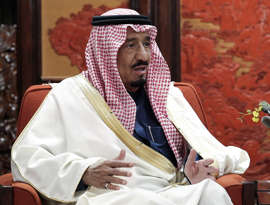
Two days after meeting with US President Barack Obama in Riyadh, and only six days after the death of his half-brother King Abdullah, Saudi Arabia’s new King Salman on Thursday further cemented his hold on power, with a sweeping shakeup that saw two sons of the late Abdullah fired, and the heads of intelligence and other key agencies replaced alongside a cabinet shuffle. Experts in Saudi politics considered these changes a “political massacre,” saying that the new king was clearly trying to erase all traces of his late half-brother.
Top officials from the Ports Authority, the National Anti-Corruption Commission and the conservative Islamic kingdom’s religious police were among those let go.
The new appointments came a week after Salman acceded to the throne following the death of Abdullah, aged about 98.
Salman also reached out directly to his subjects on Thursday. One of his more than 30 decrees ordered “two months’ basic salary to all Saudi government civil and military employees,” the Saudi Press Agency (SPA) said.
Students and pensioners got similar bonuses.
“Dear people: You deserve more and whatever I do will not be able to give you what you deserve,” the king said later on his official Twitter account.
He asked his citizens to “not forget me in your prayers.”
On the long term, Saudi rulers nevertheless have to manage the needs of a rapidly growing population plagued by structural unemployment, an economy that remains overly dependent on oil revenue and undermined by lavish subsidies, and growing demands for more freedoms and rights.
SPA said Salman “issued a royal order today, relieving Prince Khaled bin Bandar bin Abdulaziz al-Saud, Chief of General Intelligence, of his post.”
Surprisingly, General Khaled bin Ali bin Abdullah al-Humaidan became the new intelligence chief, holding cabinet rank.
Analysts deemed the decision as one of the of the “agreements between Saudi Arabia and the United States,” because usually this position is assigned to someone from inside the ruling family.
The change comes after authorities in the kingdom last year blamed suspects linked to the Islamic State of Iraq and Syria (ISIS) extremist group for shooting and wounding a Dane, and for gunning down citizens from the Shia minority sect.
Seven Shia Muslims, including children, were gunned down in the town of al-Dalwa when masked assailants fired at a crowd commemorating Ashura, one of the Shia faith’s holiest occasions.
An eighth from a neighboring village was killed when the assailants robbed his car in order to use it in the attack.
Following the killings, a royal decree dismissed deputy governor of the kingdom’s Eastern Province and Culture and Information Minister Abdulaziz Khoja from their posts.
Shias say they face discrimination in seeking education or government employment and that they are spoken of disparagingly in textbooks and by some government officials and state-funded clerics in the Wahhabi kingdom.
They also complain of restrictions on setting up places of worship and marking Shia holidays, and say that the Shia-dominated Eastern Province receives less state funding than other communities of equivalent size.
The Saudi government denies charges of discrimination but according to a 2009 Human Rights Watch report, Shia citizens in Saudi Arabia “face systematic discrimination in religion, education, justice, and employment.”
The Eastern Province saw a rise in protests in 2011 to demand its political rights and end the injustice and discrimination its people suffer at the hands of the sectarian and oppressive Saudi regime.
The Saudi regime responded to the peaceful protests by terrorizing the people of Qatif and Awamiyah, killing more than 20 people and wounding at least 58 others between 2011 and August 2012. The number of people detained in Saudi prisons exceeded 1,042, of whom 280 remain in prison, including 24 children.
Saudi judges also passed death sentences on five pro-democracy advocates in 2014, including prominent activist and cleric Nimr al-Nimr, for their part in protests.
Meanwhile, a separate decree said Prince Bandar bin Sultan, a nephew of Abdullah, was removed from his posts as secretary-general of the National Security Council and adviser to the king.
Prince Bandar was the kingdom’s ambassador to the United States for 22 years until 2005 before moving to Saudi Arabia’s Security Council. King Salman has decided to abolish the National Security Council altogether.
Two sons of the late monarch were also fired: Prince Meshaal, governor of the Mecca region, and Prince Turki, who governed the capital Riyadh, according to the decrees broadcast on Saudi television.
Super-ministry
Another of Abdullah’s sons, Prince Miteb, retained his position as minister in charge of the National Guard, a parallel army of around 200,000 men.
Salman, thought to be 79 years old and a half-brother of Abdullah, named a 31-member cabinet whose new faces include the ministers for culture and information, social affairs, civil service, and communications and information technology, among others.
Oil Minister Ali al-Naimi, Foreign Minister Prince Saud al-Faisal, and Finance Minister Ibrahim al-Assaf stayed in the cabinet of the world’s leading oil exporter.
A 50 percent fall in global oil prices since last June has left Saudi Arabia projecting its first budget deficit since 2011, but government spending is set to continue.
Salman merged the ministries of higher education and education, naming Azzam bin Mohammed al-Dakheel to head the super-ministry.
Saudi Arabia is trying to improve its basic education system and has built more universities as it seeks to diversify its oil-dependent economy.
Another decree replaced the chief of the country’s stock market regulator, ahead of a mid-year target for opening the Arab world’s largest bourse to foreign investors.
Hours after Abdullah died on January 23, Salman appointed his son, Prince Mohammed bin Salman, as defense minister.
Powerful Interior Minister Prince Mohammed bin Nayef became second in line to the throne, while Deputy Crown Prince Muqrin, 69, was elevated to king-in-waiting.
In March 2014, King Abdullah named Muqrin to the new position of deputy crown prince with the aim of smoothing succession hurdles.
Another decree stipulated that 12 security, political, economic, educational, and social councils and committees be replaced by only two councils directly related to the cabinet which is headed by the king. The first is is the Political and Security Affairs Council, headed by powerful Interior Minister Mohammed bin Nayef, and the second is the Economic and Development Affairs Council, headed by newly-appointed Defense Minister Prince Mohammed bin Salman.
Bin Nayef and bin Salman are to lead the country in the future, and fulfill their current task.
Bin Nayef is said to be particularly close to the US Administration, and is described by US media as the first Saudi man to “counter terrorism.” As for bin Salman, his appointment as defense minister and head of an economic council at once seems rather questionable, and stirred up satiric comments among Saudis.
The appointment of bin Nayef helps to solidify control by the new king’s Sudayri branch of the royal family.
Their influence had waned under King Abdullah.
In another decree, Salman appointed Adel al-Tarifi, a current manager at Al-Arabiya news channel, as the minister of information. He also announced amnesty for prisoners who have been detained for violating “public right.”
Regional heavyweight Saudi Arabia is the birthplace of Islam and home to the holy cities of Mecca and Medina.
Saudi Arabia adopts a strict version of Sunni Islam that influences all aspects of life in the Gulf kingdom.
Saudi Arabia’s strict Wahhabi interpretation of Islam is mirrored in the ideology of some of the jihadist groups that have emerged during the Syrian conflict, notably the al-Nusra Front and the Islamic State of Iraq and Syria (ISIS).
(AFP, Al-Akhbar)
Posted by Unknown at 8:31 AM No comments:
Email ThisBlogThis!Share to XShare to FacebookShare to Pinterest

In Los Angeles, Muslim women find empowerment in female-only Friday prayers

In Los Angeles, Muslim women find empowerment in female-only Friday prayers

After the traditional call to prayer, Edina Lekovic stood in front of some 150 women seated on the floor at an interfaith center in Los Angeles, and delivered a sermon, a role traditionally reserved for Muslim men.
"We have the right and responsibility to our faith," Lekovic told the women as she stood in front of banners emblazoned in gold with verses from the Koran, Islam's holy book.
Lekovic, an activist with California's Muslim Public Affairs Council, then joined the women in kneeling in prayer in the direction of Mecca, the holiest city in Islam.
Friday's gathering at the interfaith center - a former Jewish synagogue near downtown Los Angeles with Stars of David etched into the stained glass windows - aims to encourage women to participate fully in Muslim prayer and education.
Significantly, women are at the helm.
In traditional mosques, women pray separately from men, which can distance them from the lecturer. Women may also feel excluded for other reasons, such as male-only Koran studies.
Muslim women often meet for casual gatherings and prayer, but rarely do they unite in a formal setting, such as the Friday worship, under the banner of a mosque.
"The fact that this is the Friday prayer, the jumma'a, and that there's a woman officially giving the sermon, the khutbah, that's new," said Donna Auston, a doctoral candidate studying American Muslim culture at Rutgers University.
MEN AND WOMEN SHOULD FEEL AT HOME
Hussam Ayloush, of the Council on American-Islamic Relations, said some Muslims may prefer integration – not segregation – as a way to draw women into Islam.
"A mosque is a place of worship where all segments of the Muslim community, men and women ... should feel at home," he said.
After the initial call to prayer and Lekovic's sermon, the women sat in a circle under the tall arched ceiling, some with tears in their eyes, and reflected on the experience.
"I want every woman to experience what it feels like to learn from a female religious authority in the mosque," said M. Hasna Maznavi, 29, who founded the Women's Mosque of America organization with Sana Muttalib, 31, after feeling excluded from traditional mosques. They say it is the nation's first female-only mosque.
Lubna Muttalib, Sana's mother, said she has sat so far behind men at other mosques she has had to watch the sermon projected onto a screen.
"It's so good to see my khatiba in person, instead of looking at a TV screen," she said, referring to the person who gives sermons.
Maznavi hopes to unite Muslim women from diverse backgrounds and said the mosque is neither Sunni nor Shi'ite and occupies the "middle ground" of politics.
(Reporting by Daina Beth Solomon in Los Angeles; Editing by Eric M. Johnson)
Posted by Unknown at 8:14 AM No comments:
Email ThisBlogThis!Share to XShare to FacebookShare to Pinterest

EU decries discrimination against Somalia’s minority clans | Diplomat News Network

EU decries discrimination against Somalia’s minority clans | Diplomat News Network

The European Union (EU) on Friday decried the high levels of discrimination among Somalia’s minority clans.
EU Ambassador to Somalia Michele Cervone d’Urso told a forum in Nairobi that the women face double discrimination, which has relegated them to the margins of society.
“The situation is even affecting peace building efforts in the country,” d’Urso said during the launch of a report on the predicament facing Somalia’s minority clans.
Estimates indicate the Somalia’s ethnic minorities account for between 15 and 20 percent of the country’s population. He urged Somali federal and regional governments to recognize the problem.
“We are therefore urging state authorities to put in place affirmative action measures in order to build a more inclusive society,” d’Urso said.
The EU envoy said women are vulnerable to abuse, discrimination and gender based violence which has affected their ability to access sustainable livelihood. He said Somali government has made progress, but it is yet to be felt by the women minorities at the grassroots level.
“They are often ignored in the decision-making process,”he said, adding that without effective intervention, the situation of the women is unlikely to improve in the near future.
Somali Ambassador to Kenya Mohamed Americo said Somalia’s minority women are the backbone of the society. “A sustainable remedy to the situation is a change in the mindset of society,” he said.
Posted by Unknown at 8:00 AM No comments:
Email ThisBlogThis!Share to XShare to FacebookShare to Pinterest

Somali Terror Suspect's Light Sentence Raises Questions

Somali Terror Suspect's Light Sentence Raises Questions

When federal agents stopped 18-year-old Abdullahi Yusuf at the Minneapolis airport last May he had a ticket to Istanbul, Turkey. The Somali-American teen had gotten a passport just a few weeks earlier. He hadn’t told his father where he was going. But the Federal Bureau of Investigation believed he wanted to join terrorist fighters battling the Syrian regime of Bashar al-Assad.
And that, the U.S. government says, is against the law. In November, federal prosecutors charged Yusuf with conspiracy to support a terrorist organization, a felony charge that could have landed him in jail for 15 years or more.
It was the latest in a line of terror charges that U.S. officials have used in an attempt to stem the alarming number of Americans—Somali or otherwise—seeking to join foreign terrorist organizations like Al-Shabab, in Somalia, or more recently, the so-called Islamic State group in Syria.
But this week a federal judge sentenced Yusuf not to a long prison term, but to a halfway house, and a program to try and integrate him back into the community.

Community-based counterterrorism

As the Obama Administration continues to grapple with ways to keep Americans from being radicalized and joining terror groups, Yusuf’s case may be harbinger, or a signal of a shift in thinking about the problem, experts say.
“I mean, I was like, gosh, wow. I just was really surprised to see it, on the other hand, I’m really encouraged by it,” said John Horgan, director of the Center for Terrorism & Security Studies at the University of Massachusetts, Lowell. “It’s very risky, because someone’s going to have to take responsibility should something go wrong. (But) this represents a very brave step. This is what community-based counterterrorism is all about.”
Minnesota’s Minneapolis-St. Paul region has been a focus of “counter-radicalization” efforts for years now. That’s because beginning in late 2007, Somali American men began traveling to Somalia to join the radical Islamist group Al-Shabab in its fight against the secular, U.N.-backed government, and Ethiopian troops. At least 22 young men ended up there; some were killed in fighting; others returned to the United States and faced criminal terrorism charges.
The young men were a tiny proportion of the Somali American community in Minnesota, the largest of its kind in the United States, but it heightened scrutiny, and distrust.
As part of the effort to stop the flow, federal and local police waged a serious campaign of surveillance, investigation and, many Somalis say, intimidation that ended up alienating the community. The decision in 2010 to charge two women who collected clothing and money for Al-Shabab with federal terrorism charges was for many the last straw.

Waning support

Support for Shabab has waned in recent years for different reasons. At the same time, in the past 12-16 months, there’s been an uptick in men—and women—seeking to travel to Iraq and Syria to join the Islamic State militants who aim to build an Islamic state known as a caliphate there.
U.S. officials have estimated more than 100 Americans have traveled there, a number that includes at least a dozen ethnic Somalis.
Among those who went was Abdi Nur, who, prosecutors say, made his plans in conjunction with Yusuf, including shopping at a suburban Minneapolis mall. Nur left the United States the day after Yusuf was stopped by FBI agents. He was charged in November with an additional charge of providing material support for terrorists.
Other evidence cited by prosecutors in charging Yusuf were Facebook posts he had made, and messages he had exchanged with another Somali man from Minnesota who had traveled to Syria some seven weeks earlier.

Wrong message?

U.S. Attorney Andrew Luger of Minnesota, who has overseen many of the terrorism-related cases involving Somalis, has also helped spearhead efforts to rebuild bridges with the Somali community, meeting repeatedly with religious leaders, elders and community activists and asking for help.
But he opposed the lenient sentence. A spokesman, Ben Petok, declined to explain further, saying the case was still pending.
Luger is also one of three federal prosecutors scheduled to attend at a major conference next month at the White House, to discuss ways to stop radicalization and recruitment for terrorist groups.
Peter Erlinder, a St. Paul lawyer who previously represented Yusuf, said it was too early to say whether the sentence was a clear change in policy.
But, he said, “it’s a reflection of an apparent change in attitude with respect to this particular defendant.”
“If it’s a change in policy nationally, so much the better because there’s been too much overcharging, too much creation of crimes that weren’t crimes at all and this case comes very much close to that,” he said.
For some Somalis, however, the lenient sentence handed to Yusuf in fact sent the wrong message, according to Abdirazak Bihi, a Minnesota community activist whose nephew traveled to Somalia in 2008 and later was killed there, possibly trying to escape from Al-Shabab militants.
“A lot of people are worried the government is getting soft on this. Everyone is getting angry about this,” he said. “People want the government to be tough, and send a real message on this.”
Posted by Unknown at 7:54 AM No comments:
Email ThisBlogThis!Share to XShare to FacebookShare to Pinterest

South African gangs loot Somali shops in Atteridgeville | Diplomat News Network

South African gangs loot Somali shops in Atteridgeville | Diplomat News Network

Tensions flared as Somali shop owners in Brazzaville in Atteridgeville and residents clashed on Thursday.
Community members stood outside shops swearing and hurling stones at passing trucks hired to remove the goods from the stores.
During the altercation between shop owners and residents, six stores in the area were broken into and looted.
Station commander of the Atteridgeville SAPS, Brigadier Fred Kekana, said in a meeting with shop owners last Friday they had advised them to close up temporarily, citing possible tension that could spill over from the Soweto attacks.
“We told them to close up for their own safety but within an hour of that meeting they insisted on reopening.”
He said they then warned the shopkeepers to close up should there be any rumour of a pending attack.
“We have assisted them by ensuring there is visible policing constantly. There are many foreign shops around here. We don’t have enough manpower to protect all of them,” said Kekana.
The station commander said even though they had tried their best they were also dealing with land-grabs and still had to provide services to the rest of Atteridgeville.
He said the entire issue was started as 200 illegal shacks were demolished by metro police and 100 from the group decided to loot the nearby shops in retaliation.
“They wanted to speak to the councillor and when they were blocked they turned on the nearby shops.”
While police kept watch as shop owners loaded up stock, residents pounded their vehicles with stones as they were escorted to safety.
Kekana said another problem was that four to five shops were attacked at once.
“The truth of the matter is we are over-stretched.”
Arab Hassan said they were helping his cousin move his stock because he had been attacked four months before the current attacks. “They assaulted him badly. He had to spend amonth in Kalafong hospital.
By evening a covered-up body of a young boy lay in a passage.
Distraught family members refused to speak to the media and residents threatened to harm reporters if they did not leave.
Meanwhile, two Somalians were apparently injured and taken to Kalafong hospital for treatment. Ibrahim Shuriye, head of the Social Service Somali Association of SA, said: “Two Somalian shop owners were beaten and some shot by the community.”
Posted by Unknown at 7:44 AM No comments:
Email ThisBlogThis!Share to XShare to FacebookShare to Pinterest

Cash transfers to Somalia threatened, again | Minnesota Public Radio News

Cash transfers to Somalia threatened, again | Minnesota Public Radio News

Twin Cities businesses that help Somali-Americans wire cash to east Africa are again at risk of shutting down.
Merchants Bank of California is closing the accounts of Somali-American money service businesses, or MSBs, by Feb. 6, according to Oxfam.
Merchants handles a majority of MSB accounts, and the bank's decision to close them will cut off a financial lifeline to Somalia, says Oxfam's Scott Paul.
Many banks, he says, fear breaking anti-terrorism financing laws.
The move will be a hardship to Somali-Americans and their families, says Minnesota U.S. Rep. Keith Ellison.
"This is food, this is school fees, this is vital stuff," Ellison said. "This is not luxury items going through."
Merchants Bank couldn't be reached for comment.
Last June, Merchants Bank notified MSBs that it would close their accounts by late July. But in September the bank agreed to keep the accounts open.
Posted by Unknown at 7:39 AM No comments:
Email ThisBlogThis!Share to XShare to FacebookShare to Pinterest

Thursday, January 29, 2015

Over 38,000 Somali children facing starvation: UN - Yahoo News

Over 38,000 Somali children facing starvation: UN - Yahoo News

Over 38,000 Somali children are at "high risk" from dying from starvation despite hunger levels improving by almost a third across the war-torn nation, UN experts said Thursday.
The grim assessment, based on the latest data collected by the UN, comes just over three years since intense drought and war sparked famine in the Horn of Africa nation, killing more than a quarter of a million people.
In total, over 731,000 people, including 203,000 children who are severely malnourished, face "acute food insecurity", according to a joint report released by the UN's Food Security and Nutrition Analysis Unit (FSNAU) and the US-funded Famine Early Warning Systems Network(FEWS NET).
But the total number affected is a drop of 29 percent from last assessments covering the past six months, with "relatively good rains" in late 2014 helping farmers.
"Many children remain acutely malnourished, despite a small decrease in their numbers over the past six months," the statement read.
"An estimated 202,600 children under the age of five are acutely malnourished, including 38,200 who are severely malnourished and face a high risk of morbidity and death."
Three-quarters of those in dire need are those who have fled their homes, mainly due to continued fighting.
"Malnutrition rates remain stubbornly high," UN aid chief for Somalia Philippe Lazzarini said. "The outlook for 2015 is worrisome."
More than 250,000 people, half of them children, died in the devastating 2011 famine.
Fighting continues between Somalia's Al-Qaeda-affiliated Shebab rebels and government and allied forces, backed by more than 20,000-strong African Union force.
Posted by Unknown at 7:37 AM No comments:
Email ThisBlogThis!Share to XShare to FacebookShare to Pinterest

Somali political crisis delaying state rebuilding - U.N. envoy | News by Country | Reuters

Somali political crisis delaying state rebuilding - U.N. envoy | News by Country | Reuters

A political crisis that has produced Somalia's third prime minister in just over a year has delayed work to draw up a new constitution and steps needed to prepare for a referendum and election in 2016, U.N. envoy Nick Kay said on Wednesday.
Somalia is slowly recovering from two decades of conflict. A military campaign has driven Islamist rebels out of major strongholds and some refugees have begun returning home but efforts to rebuild the state have stalled.
"You are not going to have a lasting peace in Somalia without building a state," Kay, the U.N. special envoy to Somalia, told Reuters. "The delays caused by political infighting have affected progress."The goal is to put a constitution to a referendum in March 2016 that will outline a new federal structure to help overcome the regional and clan rivalries that fuelled past fighting. A vote for a new president is due to follow in September 2016.But a constitutional review commission has yet to start work, some regions in a new federal state have not been demarcated and an independent electoral commission has yet to be named."They have made progress but the timelines now are very tight," Kay said in Addis Ababa, where he was attending a summit of African Union leaders. "So they need encouraging to do more and more quickly."President Hassan Sheikh Mohamud named his third prime minister, Omar Abdirashid Ali Sharmarke, in December after a row with the previous premier. Parliament then rejected Sharmarke's first cabinet, forcing him to name a new one this week.Only when a new cabinet is in place can it name the election commission, which parliament must approve. Parliament is due to head into a recess on Feb. 5 and is not due to return until March, said Kay, threatening further delays.Western and other donors, which have pledged billions of dollars for reconstruction, have urged politicians to set aside differences, fearing al Shabaab Islamist militants can exploit the vacuum.Al Shabaab has been pushed out of major strongholds by an offensive launched last year by African peacekeepers and Somali troops. More of the country is now under government control but rebels still launch frequent gun and bomb attacks.However, with more order in some areas, Kay said a U.N.-supported programme had so far helped about 1,000 Somali refugees return home from Kenya since late last year. (Editing by Janet Lawrence)
Posted by Unknown at 7:27 AM No comments:
Email ThisBlogThis!Share to XShare to FacebookShare to Pinterest

Somalis in Soweto recall days of terror - Crime

Somalis in Soweto recall days of terror - Crime

Sheer terror is what some Somalis say they felt when frenzied mobs stormed their shops in Soweto last week, saying the well-stocked shelves were what saved their lives.
Deeq Abdul and fellow Somalis Adbinu Yusuf and Ahmed Abdi on Tuesday said so wild was the crowd that hit their Orlando supermarket last Monday that if they had been in the way, they would have been killed.
“We were in the shop going about our business when we became aware of the sounds of a big crowd. It was immediately followed by our doors being forced open and thousands of people just pouring in,” 26-year-old Abdul said.
Their initial shock was replaced by panic and horror.
“They burst into the shop and we knew that if they touched us we would die.”
But the mob of men and women, old and young, went for the shelves.
“They were all over the place, and as we ran for the back exit, we saw them pulling everything off the shelves,” Abdul said.
They hid in a neighbour’s house until the frenzy died down and the mob had left.
“They took everything. They took six huge fridges and a few smaller ones, they took the shelves and counters. They left the shop totally bare,” Yusuf added.
The trio fled to Pretoria, where they took refuge in the Pretoria West house of a Somali who has always opened his doors to countrymen seeking a place to stay during similar attacks on them and their property.
Masid Yussuf also fled for Pretoria West after his shop was looted of more than R70 000 worth of supplies and severely damaged by a large crowd.
He had been away from the shop when the looting took place that afternoon. He rushed back when his workers phoned to tell him what was happening.
“The sight that confronted me was the stuff of nightmares. I found thousands and thousands of people outside the shop, walking and running and standing around, all with their arms full of stuff from the shop.
“It was unbelievable. Most carried more than humanly possible and what fell on the floor was immediately retrieved even as they ran in the direction of the houses,” Yussuf said.
He had come from Port Elizabeth in 2013, two years after being shot at four times and hit twice during an ambush at his shop.
“I was in hospital for four months for treatment on my leg and hip,” he said.
He had never fully recovered from the attack, so when he was confronted by the sight of armed youth and looters, he was overcome by anxiety and rushed for the safety of a group of police officers who were at the scene.
The shop was wrecked.
The attack had been so violent that the open doors had been pulled off their hinges, windows were smashed and parts of the walls brought down with hammers.
The Somalis said they would return to their communities when the chaos died down, because of the good relationships they had built with their customers.
“Ignorance is what is killing our people,” said the chairman of the Gauteng Somali Association of South Africa, Abdirahman Ismail.
The fact that people were not well informed about the plight of fellow Africans and did not understand the circumstances under which they lived in South Africa instead of being at home was the root of the problem, he said.
“Criminal activities are commonplace, and because foreigners are vulnerable, they easily become targets,” he said.
Ismail said that if they left, South Africans would attack other South Africans in the vicious cycle of crime.
The Star

Posted by Unknown at 7:22 AM No comments:
Email ThisBlogThis!Share to XShare to FacebookShare to Pinterest

Wednesday, January 28, 2015

Somali suicide bomber lived in Switzerland - Africa | IOL News | IOL.co.za

Somali suicide bomber lived in Switzerland - Africa | IOL News | IOL.co.za

A suicide bomber who last week killed himself and three others at a hotel in Somalia's capital Mogadishu had previously lived in Switzerland.
A spokeswoman for the Swiss Federal Intelligence Service, NDB, said Tuesday that the agency was working on the assumption that the man of Somali origin came to Switzerland in 2008.
Carolina Bohren told The Associated Press that the bomber received temporary residency in Switzerland along with Swiss travel documents, but not Swiss citizenship.
The attacker blew himself up Thursday at the gate of the SYL hotel, used by Turkish officials. The attack bore the hallmarks of al-Shabaab, an Islamic extremist group fighting the Somali government.
Bohren said the man, who she didn't identify, notified Swiss authorities in January 2013 that he was moving away, without specifying where.
Sapa-AP

Posted by Unknown at 7:39 AM No comments:
Email ThisBlogThis!Share to XShare to FacebookShare to Pinterest

Suspect in Somali teen's death makes court appearance | Local News - KMBC Home

Suspect in Somali teen's death makes court appearance | Local News - KMBC Home

The man accused of killing a teenager at a Somali community center last month made another court appearance Monday.
Ahmed Aden is charged with first-degree murder, armed criminal action, leaving the scene of an accident and illegal use of a weapon. He attended a two-minute hearing about the case Monday.
Aden is accused of deliberately striking 15-year-old Abdisamad Shiekh-Hussein outside the community center last month. The Staley High School sophomore later died of his injuries.
The case continues to be very important for Kansas City's Somali community. Many members of the community attended Monday's hearing, which covered routine pretrial issues.
Aden has another court date in early February.
The FBI is conducting its own investigation to see whether the case qualifies for hate crime charges.
Posted by Unknown at 7:36 AM No comments:
Email ThisBlogThis!Share to XShare to FacebookShare to Pinterest

BBC News - Somali pub comments 'misrepresented', says Lib Dem MP

BBC News - Somali pub comments 'misrepresented', says Lib Dem MP

Communities Minister Stephen Williams has defended his remarks in Parliament about the threat to pubs in his constituency from population changes.
The Lib Dem MP for Bristol West said pubs in parts of the city were closing because of the decline of the "white working class" and the arrival of migrants from Somalia and elsewhere.
He said reports of his remarks had been "twisted" to suggest a focus on race.
He had simply been proposing derelict premises should be converted, he said.
The comments were made as Mr Williams was outlining a government proposal to protect community pubs.
The plan involves changing the law to prevent places listed as assets of community value being demolished or having their use changed without planning permission.
Some campaigners had called for the government to go further and impose a blanket ban on the redevelopment of all pubs without planning permission.
Arguing against a blanket ban, Mr Williams told MPs: "In my own constituency, lots of pubs have closed - but it is usually because of demographic change.
"Some parts of my constituency, which had a 'white working-class community' 20 or 30 years ago, are now populated primarily by recently arrived Somalis and other people.
"Obviously the pubs in those areas have closed, and some have been converted to other uses, but some of them are still derelict.
'No value judgement'
"What the government is proposing is to look at the public houses that are genuinely popular and valued by the community now, giving them protection that is already allowed in the Localism Act and further enhancing that protection in terms of the planning laws, saying you cannot convert this pub into another use or demolish it without planning permission."
Some reports, including one in the Daily Telegraph newspaper, with the headline "'Somali immigrants' cause pub closures", had taken his comments out of context, Mr Williams said.
"There was no value judgement in what I said. It was simply an observation," he told the BBC.
"Some pubs in the Barton Hill and Redcliffe area of my constituency have closed because of the arrival of a non-drinking Muslim population to the area.
"I could have made a point about pubs closing because of the decline of a factory or a football stadium - both of which also apply to my constituency," he said.
"I was simply saying there was no point us giving blanket protection to all pubs, as some people suggest.
"But what we are announcing is powers for people across the country to protect their much-loved pubs by triggering a planning application if they are listed as a community asset."
Mr Williams rejected any suggestion his comments had been motivated by a negative view of migration.
"I have consistently argued that immigration is a good thing," he said. "That is my view as a Liberal."
Posted by Unknown at 7:20 AM No comments:
Email ThisBlogThis!Share to XShare to FacebookShare to Pinterest

Somali prime minister appoints new Cabinet - US News

Somali prime minister appoints new Cabinet - US News

Somalia's prime minister unveiled his new Cabinet Tuesday, weeks after he withdrew his initial line-up following opposition by the parliament.
Omar Abdirashid Ali Sharmarke appointed a 20-member Cabinet, mostly political newcomers, downsizing the number from the 26-member body that was dissolved earlier this month.
Somalia's president appointed Sharmarke after the parliament ousted his predecessor, Abdiweli Sheikh Ahmed, in December, capping off a long-standing feud between Ahmed and President Hassan Sheikh Mohamud.
Last week the U.N., the European Union, the regional bloc IGAD, the African Union Mission in Somalia, the United States and Britain expressed concern over delays in the implementation of a plan to rebuild war-torn Somalia due to the political crisis.
Shamarke — who was prime minister in a previous administration — and his Cabinet face major challenges, including an insurgency by Islamist militant group al-Shabab and rebuilding the country from decades of conflict.
The United States and the U.N., among others, have warned that the political infighting in Somalia is putting at risk the recent security gains made in the country. Somalia plunged into chaos after the 1991 ouster of dictator Siad Barre. The country's weak government is currently being supported by African Union troops against the insurgency by al-Shabab.
The U.S. State Department declared al-Shabab a terrorist organization in February 2008.
Posted by Unknown at 7:07 AM No comments:
Email ThisBlogThis!Share to XShare to FacebookShare to Pinterest

Tuesday, January 27, 2015

Somali President: former ministers will be included list of cabinet | Diplomat News Network

Somali President: former ministers will be included list of cabinet | Diplomat News Network

The president of federal government of Somalia Hassan Sheik Mohamud addressing the media applauded the government security forces and the public for the role they played during Erdogan’s visit and he excused any inconvenience caused the operations launched by the security forces.
On the other hand the president described the political situation of the country and the forthcoming government of prime minster Omar Abdirashid Ali Sharmarke.
President Hassan emphasized that the prime minister will form competent government based on 4.5 clan systems adding that the government will be satisfactory all different parties of Somali people.
“Immediately the former cabinet lost confidence of the parliament, I informed the public through the media that the forthcoming government will be coalition one which will be included all parties”
Finally the president underlined that some of the former ministers will be included list of imminent cabinet.
This comes after two Somali parliamentary caucuses cautioned the prime minister against re-appointing former minsters.
Posted by Unknown at 3:18 AM No comments:
Email ThisBlogThis!Share to XShare to FacebookShare to Pinterest

'Somali immigrants' cause pub closures, says minister - Telegraph

'Somali immigrants' cause pub closures, says minister - Telegraph

Pubs are closing as a result of Somali immigrants arriving in Britain, a Government minister has said.
Stephen Williams, the Liberal Democrat communities minister, told the House of Commons that new waves of immigration replacing the “white working class” had led to the pub trade evaporating in some parts of the country.
His comments came as the Government unveiled new plans to protect pubs which are valuable to local communities.
The measures will stop pubs which meet the criteria from being demolished or converted for other uses, such as housing.
Mr Williams said "blanket protection" of every pub in the country was not possible because it would encompass some which had been abandoned by the local community because they do not drink alcohol.
"In my own constituency, lots of pubs have closed but it is usually because of demographic change,” said the minister, who represents a seat in Bristol.
"Particularly in some parts of my constituency, which used to have ... 'a white working class community' 20 or 30 years ago are now populated primarily by recently-arrived Somalis and other people.
"Obviously the pubs in that area have closed.
“Some have been converted to other uses, some of them actually are still derelict.”
It came after comments made in December by Lord Hodgson of Astley Abbotts, a Conservative, who said the growing Muslim population was one of the main reasons for pubs closing.
A series of amendments to the Infrastructure Bill were tabled including a cross-party effort to ensure pubs and other drinking establishments could not be demolished or have their use changed without planning permission.
Posted by Unknown at 3:09 AM No comments:
Email ThisBlogThis!Share to XShare to FacebookShare to Pinterest

Sunday, January 25, 2015

Questions over where aid money destined for Somalia ended up | Christian News on Christian Today

Questions over where aid money destined for Somalia ended up | Christian News on Christian Today

Millions of dollars in UN aid earmarked for impoverished Somalians is believed to be missing, Fox News reported on Tuesday. 
The money was supposed to be used for food, water, medicine, and other vital relief for Somali citizens affected by the famine of 2010-2012, but Fox says the money was diverted by charitable organisations working on behalf of the UN.  
The UN's Office of Internal Oversight Services began investigating the missing UN Common Humanitarian Fund (CHF) monies in 2012, and discovered that most of it went into the pockets of administrators at the three organisations.  
Confidential reports issued in November 2013 and May 2014 also "suggested possible payment of project funds to a terrorist group."
The UN Office for the Coordination of Humanitarian Assistance (OCHA) denied that "any CHF cases are linked to the transfer of funds to terrorist organisations."
However, investigators uncovered a 2012 email in which a UN contractor asked the head of his non-governmental organisation (NGO) for money transfers, and reported that a colleague was "pressed by al-Shabaab to do the three payments as quickly as possible." Al-Shabaab is a terrorist organisation based in Somalia. 
Of the $260 million in aid distributed by CHF between 2010-2013, $162 million was funnelled through OCHA. In 2014, UN auditors criticised OCHA for its practice of giving 80 per cent of project monies upfront, and 20 per cent after project completion.
The auditors found that OCHA provided "no assurance that the funds disbursed to NGOs were used for the intended purposes."
According to reports, the three organisations misappropriated the initial 80 per cent, and presented phony receipts, invoices, and reports to cover their tracks. Of the organisations' 21 projects, 17 had evidence of fraud.
Posted by Unknown at 11:04 AM No comments:
Email ThisBlogThis!Share to XShare to FacebookShare to Pinterest

Turkish President in Somalia to Launch Development Projects - ABC News

Turkish President in Somalia to Launch Development Projects - ABC News

Under tight security Turkish President, Recep Tayyip Erdogan, Sunday launched development projects sponsored by his government including an airport terminal in the Somali capital, Mogadishu.
Hundreds of soldiers were deployed across Mogadishu where Somali Islamist extremists have carried out terror attacks targeting Turkish interests. Erdogan, on his second visit to Somalia, was accompanied by his wife, daughter and ministers. Erdogan opened a new Turkish-built terminal for the Mogadishu airport.
Somali President Hassan Sheikh Mohamud lauded Turkey for investing in Somalia despite challenges, including insecurity, caused by decades of turmoil currently from an Islamist extremist insurgency by al-Shabab, which is allied to al-Qaida. Two days ago three people died when an al-Shabab suicide car bomber detonated explosives at a hotel where the Turkish president's advance party was staying. No Turks were injured in that incident.
African Union troops, who are bolstering Somalia's weak government against al-Shabab's insurgency, blamed the attack at the hotel on al-Shabab.
Al-Shabab espouses a strict form of Islam and has long been threatening Turkish workers and aid agencies in Somalia accusing them of spreading secularism.
A Turkish security official and a Somali student were killed in a 2013 July attack on the Turkish consulate and relief mission in Mogadishu. In Oct 2011 al-Shabab killed at least 100 Somalis when a suicide bomber detonated a truck bomb in an area where there are several ministries including the ministry of Education, most of those killed were students applying for scholarships to study in Turkey.
Under Erdogan'd leadership, Turkey has developed ties with Somalia. Turkish Airlines was the first international carrier to resume flights to Mogadishu. Turkish companies have construction projects in Somalia including roads, hospitals and the airport. Turkish non-governmental organizations are working in Somali and Turkey offers scholarships for Somali students.
Posted by Unknown at 10:33 AM No comments:
Email ThisBlogThis!Share to XShare to FacebookShare to Pinterest

US Muslims threatened after 'American Sniper'

US Muslims threatened after 'American Sniper'

Muslims are facing increased threats in the United States after the release of the movie "American Sniper," an American-Arab organization said in letters to director Clint Eastwood and star Bradley Cooper.
In the open letters released earlier this week, the American-Arab Anti-Discrimination Committee (ADC) said there has been a spike in violent threats against Muslims due to the film that portrays the story of an American sniper during the Iraq war.
"A majority of the violent threats we have seen over the past few days are (a) result of how Arab and Muslims are depicted in American Sniper," the ADC said.
The group said it had received hundreds of violent messages from viewers of the film, many of them through social media.
The ADC notified the Federal Bureau of Investigation (FBI) and local police about the threats and asked the two Hollywood stars to condemn the violent rhetoric used by filmgoers.
"Your visibility, influence, and connection to the film would be a tremendous force in drawing attention to and lessening the serious dangers facing the respective communities," the letters signed by ADC president Samer Khalaf said.
The movie released this month is based on the true story of an American solider Chris Kyle deployed in Iraq.
The film has earned six Oscar nominations and sparked a debate in the US over the occupation of Iraq and the depiction of veterans in popular culture.
Posted by Unknown at 10:01 AM No comments:
Email ThisBlogThis!Share to XShare to FacebookShare to Pinterest

Friday, January 23, 2015

Somali businessmen’s car stoned - Crime & Courts | IOL News | IOL.co.za

Somali businessmen’s car stoned - Crime & Courts | IOL News | IOL.co.za

People threw stones at the van of four Somali nationals who had packed up their shop in Soweto on Thursday following clashes between locals and foreigners.
A crowd stood around the van, which the men were loading with stock, in Heald street, Meadowlands.
Two police vans were on the scene and officers stood close to make sure the crowd did not intimidate the foreign businessmen.
A boy in school uniform shouted: “They must leave, they want to kill us.”
One of the Somali men, Shineh Farrah Abdillah, responded: “Why would I want to kill you, you are my brother”, to which the boy answered: “You are not my brother”.
The crowd became impatient and as the men finished packing their van and started the vehicle people began throwing stones.
Abdillah, who said he had been in South Africa since 2011, told Sapa: “The police were trying to help us but now I'm worried about myself because of these people.”
Earlier on Thursday, Winnie Madikizela-Mandela was reportedly in Meadowlands to try speak to the people.
Police were on high alert in Soweto, the third day of clashes that left at least two people dead.
Several shops owned by Ethiopians, Pakistanis and Somalis were closed in Snake Park following the attacks.
Residents went on a rampage looting shops and attacking foreigners after a teenager was shot dead in Snake Park. Mthetheleli Siphiwe Mahori, 14, was shot dead, allegedly by a foreign shop owner on Monday. He was apparently part of a group that tried to rob the shop.
The violence spilled over to Braamfischerville, Dobsonville, Emdeni, Zola and Protea Glen.
Sapa

Posted by Unknown at 7:54 AM No comments:
Email ThisBlogThis!Share to XShare to FacebookShare to Pinterest

Saudi Arabia acts fast on succession after king's death

Saudi Arabia acts fast on succession after king's death

Saudi Arabia's new King Salman appointed a grandson of the founding monarch into the line of succession for the first time on Friday, moving fast after the death of King Abdullah to quell fears of dynastic instability at a time of regional turmoil.
The appointment of Interior Minister Prince Mohammed bin Nayef as Deputy Crown Prince was highly unusual for its speed, Saudis said, ahead of the burial of the monarch due on Friday afternoon following his death in the early hours. Such appointments normally take several days.
Mohammed bin Nayef becomes the first grandson of the kingdom's founding monarch, King Abdulaziz, known as Ibn Saud, to take an established place in the line of succession.
All Saudi kings since his death in 1953 have been his sons and the move into the next generation had raised the prospect of a palace power struggle. King Salman also appointed his own son Mohammed bin Salman Defense Minister and head of the royal court.
Salman, thought to be 79, now takes over as the ultimate authority in a country that faces long-term domestic challenges compounded by the plunging price of oil and the rise of the Islamic State militant group in Iraq and Syria, which vows to toppled the Al Saud.
Saudi Arabia's Crown Prince Salman bin Abdul Aziz al-Saud meets with Chinese Premier Li Keqiang at Ziguangge Pavilion in the Zhongnanhai leaders' compound in Beijing in this file photo from March 14, 2014. 
© Lintao Zhang/REUTERS Saudi Arabia's Crown Prince Salman bin Abdul Aziz al-Saud meets with Chinese Premier Li Keqiang at Ziguangge Pavilion in the Zhongnanhai leaders' compound in Beijing in this file photo from March 14, 2014.
In his first speech as king, shown live on Saudi television on Friday, Salman pledged to maintain the same approach to ruling the world's top oil exporter and birthplace of Islam as his predecessors and also called for unity among Arab states.
"We will remain, God willing, holding the straight course that this country has walked on since its establishment by the late King Abdulaziz," he said.
Salman must navigate a white-hot rivalry with Shi'ite Muslim power Iran playing out in Iraq, Syria, Yemen, Lebanon and Bahrain, open conflict in two neighboring states, a threat from Islamist militants and bumpy relations with the United States.
Reputedly pragmatic and adept at managing the delicate balance of clerical, tribal, royal and Western interests that factor into Saudi policy making, Salman appears unlikely to change the kingdom's approach to foreign affairs or energy sales.
But oil prices jumped on Friday as news of Abdullah's death added to uncertainty in energy markets already facing some of the biggest shifts in decades.
By immediately announcing the appointment of his youngest half-brother Muqrin bin Abdulaziz as Crown Prince, King Salman moved decisively to end speculation about the direction of the royal succession and splits in the ruling family.
However, Saudi analysts pointed out that despite this move to demonstrate a smooth succession and respect the wishes of Abdullah, who had decreed that Muqrin should follow Salman, it is not clear how much power he will have as crown prince.
"Muqrin is not as conservative as Salman, but we will see how much of a role he will play in the new reign. According to the Basic Law, the crown prince cannot do more than what he is assigned to by the king," said Khalid al-Dakheel, a political science professor in Riyadh.
REFORM LEGACY
Many Saudis in a country with a young population will be unable to recall a time before King Abdullah's rule, both as monarch from 2005 and as de facto regent for a decade before that.
His legacy was an effort to overhaul the kingdom's economic and social systems to address a looming demographic crisis by creating private sector jobs and making young Saudis better prepared to take them.
"I think (Salman) will continue with Abdullah's reforms. He realizes the importance of this. He's not conservative in person, but he values the opinion of the conservative constituency of the country," said Jamal Khashoggi, head of a news channel owned by a Saudi prince.
However, Abdullah's reforms did not stretch to politics, and after the Arab spring his security forces clamped down on all forms of dissent, imprisoning outspoken critics of the ruling family alongside women drivers and Islamist militants.
As the Saudi population grows and with the sharp decline in oil prices globally, the Al Saud will increasingly struggle to maintain its generous spending on social benefits for ordinary people, potentially undermining its future legitimacy in a country where there are no elections, analysts say.
King Salman has previously spoken against the idea of introducing democracy in Saudi Arabia in comments to American diplomats recorded in embassy cables later released by WikiLeaks.
UNMARKED GRAVE
In keeping with Muslim traditions, Abdullah's body, clothed in white and shrouded in a simple cloth, will be carried on an ambulance stretcher by relatives to rest in the mosque before being borne to the cemetery and buried in an unmarked grave.
Prayers in the mosque will be led by King Salman and attended by Muslim heads of state and other senior figures, including President Abdel Fatteh al-Sisi of Egypt, one of Abdullah's closest allies after the Arab spring uprisings.
Non-Muslim dignitaries will visit to pay respects to the new monarch and crown prince, and other members of the Al Saud dynasty, in the coming days.
Later, following the evening prayer an hour after sunset, King Salman and Crown Prince Muqrin will receive pledges of allegiance from other ruling family members, Wahhabi clerics, tribal chiefs, leading businessmen and other Saudi subjects.
In the kingdom's strict Wahhabi sect of Sunni Islam, ostentatious displays of grief are frowned upon: after previous deaths of Saudi monarchs and other top royals, there was no official period of mourning and flags hung at full mast.
Despite a surge of sorrowful messages from Saudis on social media, that religious constraint on public commemorations meant there were no signs in Riyadh's streets early on Friday that the country's long-time ruler had died.
(Additional reporting by Rania El Gamal and Sami Aboudi in Dubai; writing by William Mclean; editing by Philippa Fletcher)
Posted by Unknown at 7:42 AM No comments:
Email ThisBlogThis!Share to XShare to FacebookShare to Pinterest

Thursday, January 22, 2015

Somalia’s President orders use of Somali language as official | Diplomat News Network

Somalia’s President orders use of Somali language as official | Diplomat News Network

Somali President Hassan Sheikh Mohamud today led celebrations to commemorate the adoption of the standard written form of the Somali language – first written down 42 years ago. Attending the celebrations in Mogadishu were the Speaker of the Federal Parliament Mohamed Sheikh Osman Jawari, interim Minister of Information, Mustaf Sheikh Ali Dhuhulow, interim Minister for Higher Education Duale Mohamed, parliamentarians, scholars, civil society members and other distinguished guests.
Speaking at the commemoration, the President said, “The writing down of the Somali language 42 years ago is one of the most important milestones in the history of Somalia. Our language links all Somali people in Somalia, across the Horn of Africa and throughout the world.
“Developing and continuing to use a mother tongue is very important. Nations like China and Japan have deliberately educated their people in their own languages, which has had a huge positive impact politically, economically and development-wise.”
The President underscored the importance of the Somali language by instructing all Somali institutions to use Somali as their official language of communication, saying, “We need to protect and promote our language. From this point on, all internal documentation should be drafted in Somali, rather than another foreign language.” The President said that the use of foreign languages in government offices should be used appropriately, for example, for external communication purposes with foreign institutions, countries and partners.
The President announced the creation of a regional language academy for preserving and progressing the Somali language: “Soon we will lay the foundation of the building of a new regional Somali language academy in Mogadishu to serve all the Somali people living in this region. I would like to thank President Ismail Omar Gelle of Djibouti for promoting the Somali, and supporting the establishment of the regional language academy to be opened in Somalia- acknowledging that our country is the mother of developing and promoting the Somali language.”
The President also urged the preparation and implementation of a national Somali language curriculum, adding that efforts to realize these initiatives are underway. “We need to have our own curriculum in Somali language. As you know, the program of developing and modernising our curriculum was affected by the civil war. Now the time has come to realise our dreams of having a national curriculum in our language; a curriculum that will prepare the next generation to support the Somali-led and owned development of our country.”
The President called for the re-building and celebration of historical and cultural monuments, including museums, libraries and national commemoration monuments destroyed during the civil war.
Posted by Unknown at 7:57 AM No comments:
Email ThisBlogThis!Share to XShare to FacebookShare to Pinterest

Turkey set to build economic zone in Djibouti: Minister Anadolu Agency

Turkey set to build economic zone in Djibouti: Minister Anadolu Agency

Turkey is set to build an economic zone in Djibouti as part of the former's efforts to encourage the Turkish business community to invest in the Horn of Africa nation at a large scale and to boost economic cooperation between the two countries, a Djiboutian minister said.

"The Turkish companies will assemble and process goods and thereby easily export them to East African region and overseas," Djiboutian Finance and Economic Minister Elias Moussa Daweleh told The Anadolu Agency in an exclusive interview.

"The economic zone will create job opportunities for Djiboutian along with facilitating fertile economic conditions to Turkish investors," the minister added.

Turkish President Recep Tayyip Erdogan is due to visit Djibouti for two days starting Jan. 23, leading a 120-member delegation, including cabinet ministers and investors.

During Erdogan's two-day stay, Daweleh said, he is due to sign several economic cooperation agreements with his Djiboutian counterpart Ismail Omar Guelleh.

"The Turkish government and business community believe that investing in Djibouti is a great opportunity to have access to the East African market and African continent as a whole," the minister said.

"Turkish business leaders are very much aggressive this time to penetrate the African market and this will be realized through Djibouti, which is a gateway to the African market," he went on to say.

He added that the enhanced trade cooperation between his country and Turkey would also benefit neighboring Ethiopia – another stop in Erdogan's looming trip to region.

Ethiopia's economy is naturally interdependent with Djibouti's in multiple ways, the minister said.

"Djibouti and Ethiopia are interlinked with infrastructure, which would help the development of Turkish investments in both countries," he said.
Posted by Unknown at 7:46 AM No comments:
Email ThisBlogThis!Share to XShare to FacebookShare to Pinterest

Gates foundation sees huge gains against disease, poverty by 2030

Gates foundation sees huge gains against disease, poverty by 2030


Worldwide child deaths will be halved over the next 15 years, polio, guinea worm and river blindness will be eradicated, and there will be a single-dose cure for malaria.
The predictions appear in the annual letter from the Bill & Melinda Gates Foundation, chaired by the Microsoft Corp co-founder and former chief executive and his wife.
Released on Thursday, the letter predicts a long list of breakthroughs in global health and development by 2030, including long-elusive milestones such as Africa being able to feed itself rather than depend on food imports.
However, none of this will be achieved easily.
"You need some breakthroughs," Melinda Gates said in an interview.
The world's wealthiest foundation had helped produce big advances before, including vaccines against the childhood killers rotavirus and pneumonia, making vaccines "our greatest success," Bill Gates said in the interview.
Established in 2000, the foundation distributed $3.6 billion in grants in 2013, in particular for global health and development, and had $42.3 billion in assets as of late 2014.
"We are doubling down on the bet we made 15 years ago, and picking ambitious goals for what's possible 15 years from now," they wrote. "The lives of people in poor countries will improve faster in the next 15 years" than ever before.
In 1990, 10 percent of the world's children died before age 5. That number is now 5 percent. By 2030, only one in 40 will die that early thanks to healthier childcare practices such as breastfeeding, better sanitation and vaccines.
Gates, Co-chair of the Bill & Melinda Gates Foundation, listens to a question during a news conference before her address to the 67th World Health Assembly in Geneva: Melinda Gates, Co-chair of the Bill & Melinda Gates Foundation, listens to a question during a news conference before her address to the 67th World Health Assembly at the United Nations European headquarters in Geneva May 20, 2014. 
© REUTERS/Denis Balibouse Melinda Gates, Co-chair of the Bill & Melinda Gates Foundation, listens to a question during a news conference before her address to the 67th World Health Assembly at the United Nations European headquarters in Geneva May 20, 2014.
In the next 15 years, they believe farmers in Africa will have access to better fertilizer and to drought- and disease-resistant crops, allowing yields to double. And donated drugs, such as those distributed free to 800 million people last year, can stop polio, elephantiasis and other scourges.
The foundation is also one of the largest donors to the World Health Organization, which has been slammed for a chaotic and belated response to West Africa's Ebola epidemic last year.
"We could have made this epidemic smaller," Bill Gates said. Aid group Doctors Without Borders "is the only one to come out of this with an A."
He said, however, that the WHO is doing a good job of being self-critical about its Ebola response.
"I hope we use this epidemic to learn for the next one, because there will be a next one," Gates added.
(Reporting by Sharon Begley. Editing by Andre Grenon)
Posted by Unknown at 7:36 AM No comments:
Email ThisBlogThis!Share to XShare to FacebookShare to Pinterest

Indonesian divers recover 6 more bodies from AirAsia crash

Indonesian divers recover 6 more bodies from AirAsia crash

Indonesian divers have retrieved six more bodies from waters around the fuselage of the AirAsia jetliner that crashed in December in seas near western Indonesia.
Suryadi Bambang Supriyadi, operational director of the National Search and Rescue Agency, said the bodies were being flown to Pangkalan Bun, the nearest city to the crash site.
So far 59 bodies have been recovered from AirAsia Flight 8501, which plunged into the Java Sea with 162 people while en route from Surabaya, Indonesia's second-largest city, to Singapore.
Rescuers are still struggling to lift the fuselage and what appears to be the plane's cockpit from the seabed at a depth of 30 meters (100 feet).
Posted by Unknown at 7:31 AM No comments:
Email ThisBlogThis!Share to XShare to FacebookShare to Pinterest

Australian boy, 4, gets 'world first' artificial pancreas

Australian boy, 4, gets 'world first' artificial pancreas

A four-year-old Australian boy has been fitted with an artificial pancreas in what researchers said was a world first treatment for managing type 1 diabetes.
Xavier Hames became the first patient following clinical trials to use the new device, which looks like an mp3 player and is attached to his body using several tubes inserted under the skin.
The insulin pump system is meant to replace the need to closely manage the impact of the disease -- which occurs when people do not produce insulin, a hormone that regulates blood sugar -- such as through daily injections.
"The technology mimics the biological function of the pancreas to predict low glucose levels and stop insulin delivery," Western Australia's health department said in a statement issued late Wednesday.
"This in turn avoids the serious consequences of low glucose such as coma, seizure and potential death."
It was not clear when the procedure was carried out.
The Juvenile Diabetes Research Foundation (JDRF), a non-profit organisation which funded the research that led to the procedure, said the technology tracks glucose levels and stops insulin delivery up to 30 minutes before a predicted hypoglycaemic attack happens.
The attacks are sparked by low glucose levels and mostly take place at night when patients may not be able to react or recognise the potentially fatal episode, said Professor Tim Jones of Perth's Princess Margaret Hospital for Children, where Hames was fitted with the system.
"This device can predict hypoglycaemia before it happens and stop insulin delivery before a predicted event," Jones, one of the lead doctors involved in the research, said in a statement.
"This coupled with the fact that the pump automatically resumes insulin (delivery) when glucose levels recover is a real medical breakthrough."
Hames's mother Naomi said the device had already improved the life of her son, who has been suffering from the disease since he was 22 months old.
"Having the pump gives us the reassurance that Xavier is safe when we are all asleep at night, and during the day," she said.
"It is also waterproof meaning that he can enjoy water sports and activities as much as his friends and family."
The device was developed after five years of clinical trials at the Princess Margaret Hospital for Children and at other Australian hospitals. It is reported to cost about Aus$10,000 (US$8,100).
Posted by Unknown at 7:28 AM No comments:
Email ThisBlogThis!Share to XShare to FacebookShare to Pinterest

Houthis welcome Yemeni president's concessions but gunmen remain

Houthis welcome Yemeni president's concessions but gunmen remain

Yemen's Houthi rebels welcomed on Thursday proposed concessions by the government on power-sharing but their gunmen still held positions outside the residence of President Abd-Rabbu Mansour Hadi, who remains a virtual prisoner there.
Hadi said on Wednesday he was ready to accept Houthi demands which also include constitutional change, yielding to pressure from the Shi'ite group whose fighters battled their way into the presidential palace this week, after seizing an aide to the president.
A Houthi politburo member said Hadi's concessions were in line with a peace deal which his group, whose official name is Ansarullah, signed with other political parties when they seized the capital Sanaa in September - a move that helped to cement the rebels' position as Yemen's de facto powerbrokers.
"The latest agreement is a series of timed measures to implement the peace and partnership accord, which shows that Ansarullah were not planning to undermine the political process," politburo member Mohammed al-Bukhaiti told Reuters.
"The agreement is satisfactory because it confirms what is most important in the partnership agreement," he said.
The withdrawal of the gunmen, and the release of presidential aide Ahmed Awad bin Mubarak could happen in the next three days if the authorities committed to implementing the agreement fully, al-Bukhaiti added.
The rebels' rise to influence has caused chaos in Yemen and resulted in a shift in its complex web of tribal, religious and regional allegiances. In addition, the Houthis are players in a regional struggle between neighboring Saudi Arabia and Shi'ite Iran.
Suspecting Iranian complicity, the Sunni Muslim authorities in Riyadh cut most of their financial aid to Yemen after the Houthis' takeover of the capital.
Hadi said on Wednesday he was ready to accept demands for constitutional change and power sharing with the Houthis. Conceding to a major demand, he confirmed in a statement that the draft constitution was subject to amendment and said all sides had agreed that government and state institutions, schools and universities should rapidly return to work.
He also said the Houthis had agreed to leave his private residence and the presidential palace, and to free bin Mubarak, a former presidential nominee whom the Houthis seized on Saturday during a standoff.
But the capital remained largely shut down, witnesses said, even though the airport and seaport in the southern city of Aden resumed work on Thursday, having closed for a day in protest at the Houthi offensive against Hadi's administration.
STAYING PUT
Clusters of Houthi fighters were dotted around the perimeter of the presidential palace on Thursday. At Hadi's residence, sentry points normally used by presidential guards were empty, and a group of Houthis with an army vehicle were parked at a main entrance.
"The Houthis will not withdraw. They have agreed in the past to withdraw from Sanaa, but they did not," said Mohammed Said, a local resident standing close to Hadi's residence.
Said he thought they would procrastinate to achieve more demands and then get ready to take control of Marib, an oil-rich province east of Sanaa, where al Qaeda operates.
Another Houthi official told Reuters he expected Hadi to announce a decision on government posts, after which the group would begin procedures for the release of bin Mubarak and the gradual withdrawal from the presidential buildings.
"And the complete withdrawal will coincide with the completion of all the decisions related to the deal signed yesterday," the Houthi official said, declining to be identified.
But Yemen's Information Minister Nadia al-Saqqaf expressed scepticism over the Houthi's intentions. "Ahmed Mubarak is still (the) Houthis' hostage," she wrote on her Twitter account. "They got what they want. Why they should fulfill their promise?"
A source close to the presidency said the Houthis have "gradually" begun to withdraw from Hadi's private residence. "Presidential security will be redeployed to their positions in the next two days," the source told Reuters.
(Additional reporting by Mohammed Mokhashaf in Aden; Writing by Sami Aboudi; Editing by Raissa Kasolowsky and David Stamp)
Posted by Unknown at 7:22 AM No comments:
Email ThisBlogThis!Share to XShare to FacebookShare to Pinterest

BBC News - Somali car bomb explodes outside Mogadishu hotel

BBC News - Somali car bomb explodes outside Mogadishu hotel

A car bomb has exploded in the Somali capital outside the gates of a hotel in a heavily secured area near the presidential palace.
Police said Turkish delegates were meeting at the SYL Hotel before Friday's visit by Turkey's president to Mogadishu, Reuters news agency reports.
"The Turkish delegates are safe inside the hotel," a police captain is quoted as saying.
Al-Qaeda-linked militants often carry out attacks in Mogadishu.
It will be President Recep Tayyip Erdogan's second visit to Somalia - he first visited as Turkey's prime minister during the famine of 2011.
Since then Turkey has taken a lead in helping Somalia's government rebuild roads, schools and hospitals.
Turkish companies are also refurbishing Mogadishu's port and airport.
Posted by Unknown at 7:09 AM No comments:
Email ThisBlogThis!Share to XShare to FacebookShare to Pinterest

Wednesday, January 21, 2015

The States of Our Union ... Are Not All Strong - Margaret Slattery - POLITICO Magazine

The States of Our Union ... Are Not All Strong - Margaret Slattery - POLITICO Magazine

The good news, at least for 5.4 million Americans, is that Minnesota—with improvements in employment, infant mortality and the obesity rate—has nudged its way into a tie for the top spot, giving the Midwest a share of New Hampshire’s repeat No. 1 showing.
Last year, Politico Magazine heralded President Barack Obama’s State of the Union address with an appraisal of the state of the states of the union, which we found, contra that favorite presidential declaration, were not all “strong.” Despite the disgruntled response from those states that ended up at the bottom of the list (including a letter to the editor from the governor of Mississippi himself), we decided once again to run the latest data through our highly scientific, incontrovertible ranking process—inspired, after all, by a 1931 H.L. Mencken magazine series delicately called “The Worst American State.”
Mencken might not have lived in the era of big data, let alone cultural sensitivity. But taking as granted a few of his basic ideas—that education, health and wealth generally make us better off, while crime, unemployment and death do not—we compiled 14 existing rankings of the 50 states and the District of Columbia, using the most recent data available from sources like the Census Bureau, the FBI and the Centers for Disease Control and Prevention. Then, we averaged out each state’s 14 rankings to come up with a master list.
Yes, I’m sorry to say, the state that Mencken deemed “worst”—Mississippi—again falls last on our list this year. (It is, after all, the poorest and, in some ways, sickest state, as Sarah Varney reported for us last year.) The good news, at least for 5.4 million Americans, is that Minnesota—with improvements in employment, infant mortality and the obesity rate—has nudged its way into a tie for the top spot, giving the Midwest a share of New Hampshire’s repeat No. 1 showing.
 
D.C., Maine and Maryland saw the biggest rises in the ranks, each going up six spots, while Wyoming, one of the few states with a higher unemployment rate this year versus last, saw the biggest drop, from 6 to 16. That’s still much higher than Mencken’s rank of 30. So there’s hope for all.
***

Overall rank (1 = best)

RankStateGovernor
1MinnesotaMark Dayton (D)
1New HampshireMaggie Hassan (D)
3VermontPeter Shumlin (D)
4UtahGary Herbert (R)
5ColoradoJohn Hickenlooper (D)
6MassachusettsCharlie Baker (R)
7IowaTerry Branstad (R)
8MainePaul LePage (R)
9WashingtonJay Inslee (D)
10New JerseyChris Christie (R)
11MontanaSteve Bullock (D)
12NebraskaPete Ricketts (R)
13ConnecticutDannel Malloy (D)
13MarylandLarry Hogan (R, elect)
15North DakotaJack Dalrymple (R)
16WyomingMatthew Mead (R)
17WisconsinScott Walker (R)
18VirginiaTerry McAuliffe (D)
19HawaiiDavid Ige (D)
19IdahoButch Otter (R)
21South DakotaDennis Daugaard (R)
22KansasSam Brownback (R)
23AlaskaBill Walker (I)
23PennsylvaniaTom Wolf (D)
25OregonJohn Kitzhaber (D)
26DelawareJack Markell (D)
27IllinoisBruce Rauner (R)
28Rhode IslandGina Raimondo (D)
29New YorkAndrew Cuomo (D)
30OhioJohn Kasich (R)
31CaliforniaJerry Brown (D)
32IndianaMike Pence (R)
33MissouriJay Nixon (D)
34MichiganRick Snyder (R)
35TexasGreg Abbott (R)
36ArizonaDoug Ducey (R)
37North CarolinaPat McCrory (R)
38FloridaRick Scott (R)
39NevadaBrian Sandoval (R)
40District of ColumbiaMuriel Bowser (D, mayor)
41New MexicoSusana Martinez (R)
42KentuckySteve Beshear (D)
43GeorgiaNathan Deal (R)
44OklahomaMary Fallin (R)
45West VirginiaEarl Ray Tomblin (D)
46South CarolinaNikki Haley (R)
47AlabamaRobert Bentley (R)
48TennesseeBill Haslam (R)
49ArkansasAsa Hutchinson (R)
50LouisianaBobby Jindal (R)
51MississippiPhil Bryant (R)
Posted by Unknown at 5:50 PM No comments:
Email ThisBlogThis!Share to XShare to FacebookShare to Pinterest
Newer Posts Older Posts Home
Subscribe to: Comments (Atom)
IQ Test
  Minnesota Time
  Mogadishu Time

Islamic Hijri Calendar

Worldwide Islamic Prayer Times

Worldwide Islamic Prayer Times

Subscribe To

Posts
Atom
Posts
All Comments
Atom
All Comments

Followers

How you rate this article

Blog Archive

  • ►  2017 (3)
    • ►  January (3)
  • ►  2016 (19)
    • ►  December (4)
    • ►  July (5)
    • ►  June (2)
    • ►  May (8)
  • ▼  2015 (499)
    • ►  November (1)
    • ►  October (6)
    • ►  September (4)
    • ►  August (11)
    • ►  July (78)
    • ►  June (63)
    • ►  May (37)
    • ►  April (54)
    • ►  March (53)
    • ►  February (83)
    • ▼  January (109)
      • Somalia making progress against Shabaab, 31 Januar...
      • As Somali-American fights no-fly list, FBI says hi...
      • South Africa riots raise worry about anti-foreign ...
      • Saudi Arabia: King Salman fires late King’s sons -...
      • In Los Angeles, Muslim women find empowerment in f...
      • EU decries discrimination against Somalia’s minori...
      • Somali Terror Suspect's Light Sentence Raises Ques...
      • South African gangs loot Somali shops in Atteridge...
      • Cash transfers to Somalia threatened, again | Minn...
      • Over 38,000 Somali children facing starvation: UN ...
      • Somali political crisis delaying state rebuilding ...
      • Somalis in Soweto recall days of terror - Crime
      • Somali suicide bomber lived in Switzerland - Afric...
      • Suspect in Somali teen's death makes court appeara...
      • BBC News - Somali pub comments 'misrepresented', s...
      • Somali prime minister appoints new Cabinet - US News
      • Somali President: former ministers will be include...
      • 'Somali immigrants' cause pub closures, says minis...
      • Questions over where aid money destined for Somali...
      • Turkish President in Somalia to Launch Development...
      • US Muslims threatened after 'American Sniper'
      • Somali businessmen’s car stoned - Crime & Courts |...
      • Saudi Arabia acts fast on succession after king's ...
      • Somalia’s President orders use of Somali language ...
      • Turkey set to build economic zone in Djibouti: Min...
      • Gates foundation sees huge gains against disease, ...
      • Indonesian divers recover 6 more bodies from AirAs...
      • Australian boy, 4, gets 'world first' artificial p...
      • Houthis welcome Yemeni president's concessions but...
      • BBC News - Somali car bomb explodes outside Mogadi...
      • The States of Our Union ... Are Not All Strong - M...
      • Somalia Ratifies Convention On The Rights Of The C...
      • New Oxfam report says half of global wealth held b...
      • News Analysis: Somali PM faces huge task to form a...
      • U.S. Signals Shift on How to End Syrian Civil War ...
      • Somalia will be the Next Oil Superpower in the Wor...
      • Twin Cities-based Somali youth group seeks funding...
      • Twin Cities-based Somali youth group seeks funding...
      • Somalia to take legal procedure against ARC , a Ch...
      • Uganda judiciary clears two Somali women of terror...
      • ‘Love to Prophet Mohammed’: Crowds protest Charlie...
      • Ceasefire reached in Yemen after day of heavy figh...
      • Fla. boy's circumcision spurs lengthy legal battle...
      • Somali diaspora conference highlights, Rwanda | Di...
      • Moroccan Mohamed El Makouli in France stabbed to d...
      • Health worker's journey fuels work with Somali fam...
      • The Story of Prophet Muhammad and the Jewish Schol...
      • Somali PM Dissolves Cabinet
      • 2014 Breaks Heat Record, Challenging Global Warmin...
      • Duke reverses decision to allow Muslim call to pra...
      • US, Italy 'Aggressively Monitored' Italian Muslims...
      • Death Threats Received At London Mosque
      • France's Hollande defends freedom of speech after ...
      • Hackers announce 'World War III' on Twitter
      • Sun News : Justice of the peace benched, accused o...
      • Somali drought causing death | Africa | Worldbulle...
      • Lawyers for Minnesota Terror Suspect Propose Civic...
      • Ethiopian radio: 2 Britons and a Somali national j...
      • Somali Author Nuruddin Farah Speaks Truth to Power...
      • Over 100 Somali lawmakers plan to block cabinet ap...
      • Satellite Images Show Horrifying Scale Of Destruct...
      • HS Senior Hafid Yassin's Dunk goes viral, News Sto...
      • Romania: A safe stop on the road to resettlement f...
      • Children's ombudsman slams IND over Somali girls a...
      • From Minnesota Chamber of Commerce’s Bill Blazer: ...
      • allAfrica.com: Somalia Fights Govt Impersonators O...
      • Charlie Hebdo’s Defiant Muhammad Cover Fuels Debat...
      • Erdogan blasts Netanyahu for 'daring' to attend Pa...
      • UNFPA - United Nations Population Fund | A safe ha...
      • 2014 – The Year in Review: Part II (July – Decembe...
      • 2014 – The Year in Review: Part I (January – June)...
      • Lawyer says mosque theft suspect to surrender afte...
      • Somali prime minister names cabinet of 60 people -...
      • German newspaper that reprinted Muhammad cartoons ...
      • Communiqué of 53rd Extra-Ordinary Session of the I...
      • Unity rallies in Paris and abroad honor 17 victims...
      • Boumeddiene entered Turkey Jan 2, may be in Syria:...
      • Nigeria appeals for support after 'deadliest' Boko...
      • Teen 'in shock' after wrongly linked to Charlie He...
      • Indonesia divers find black box of AirAsia plane: ...
      • Muslim worker at Paris kosher grocer saved custome...
      • East Africa ministers meet in Somalia for peace pu...
      • One Suspect Surrenders in Attack on French Newspap...
      • BBC News - Charlie Hebdo: Gun attack on French mag...
      • Sun News : 'It's Somalis killing each other': Calg...
      • 7 Shabaab, 2 Somali soldiers killed in Galgala cla...
      • Palestinians Seen Gaining Momentum in Quest for St...
      • Somali Actor Star Gets Hollywood Film Role
      • Abbas seeks to re-submit statehood bid to U.N. Sec...
      • Afghan leader queries exit deadline
      • Foreigners fighting Islamic State in Syria: who an...
      • Indonesia naval captain says may have located miss...
      • Bombing targets U.S.-trained Somali forces | News ...
      • Car bomb targeting security forces explodes in Som...
      • Somalia dismisses Ebola scare - Yahoo News
      • UN Points to Progress in Battling Al-Shabab in Som...
      • Yemen arrests 2 European and 1 Somali Al-Qaida sus...
      • Calgary's Somali community saddened by 2 deaths in...
      • Deported from Ireland, attacked and left to die
      • Abdullahi Ahmed's death in Calgary shooting worrie...
  • ►  2014 (1071)
    • ►  December (84)
    • ►  November (75)
    • ►  October (95)
    • ►  September (88)
    • ►  August (66)
    • ►  July (82)
    • ►  June (79)
    • ►  May (90)
    • ►  April (100)
    • ►  March (100)
    • ►  February (117)
    • ►  January (95)
  • ►  2013 (653)
    • ►  December (60)
    • ►  November (50)
    • ►  October (51)
    • ►  September (19)
    • ►  August (32)
    • ►  July (125)
    • ►  June (112)
    • ►  May (47)
    • ►  April (50)
    • ►  March (44)
    • ►  February (11)
    • ►  January (52)
  • ►  2012 (792)
    • ►  December (31)
    • ►  November (42)
    • ►  October (8)
    • ►  September (53)
    • ►  August (77)
    • ►  July (95)
    • ►  June (64)
    • ►  May (35)
    • ►  April (62)
    • ►  March (81)
    • ►  February (89)
    • ►  January (155)
  • ►  2011 (1720)
    • ►  December (148)
    • ►  November (172)
    • ►  October (119)
    • ►  September (132)
    • ►  August (219)
    • ►  July (147)
    • ►  June (183)
    • ►  May (117)
    • ►  April (98)
    • ►  March (117)
    • ►  February (128)
    • ►  January (140)
  • ►  2010 (1004)
    • ►  December (128)
    • ►  November (111)
    • ►  October (159)
    • ►  September (137)
    • ►  August (90)
    • ►  July (80)
    • ►  June (61)
    • ►  May (47)
    • ►  April (191)
  • ►  2009 (2126)
    • ►  August (59)
    • ►  July (324)
    • ►  June (369)
    • ►  May (376)
    • ►  April (386)
    • ►  March (302)
    • ►  February (228)
    • ►  January (82)
  • ►  2008 (10)
    • ►  December (10)
Watermark theme. Powered by Blogger.